EMI option available for all courses

17 Nov 2026
Soumya Rudra
Education Tips
SAP FICO career in 2026
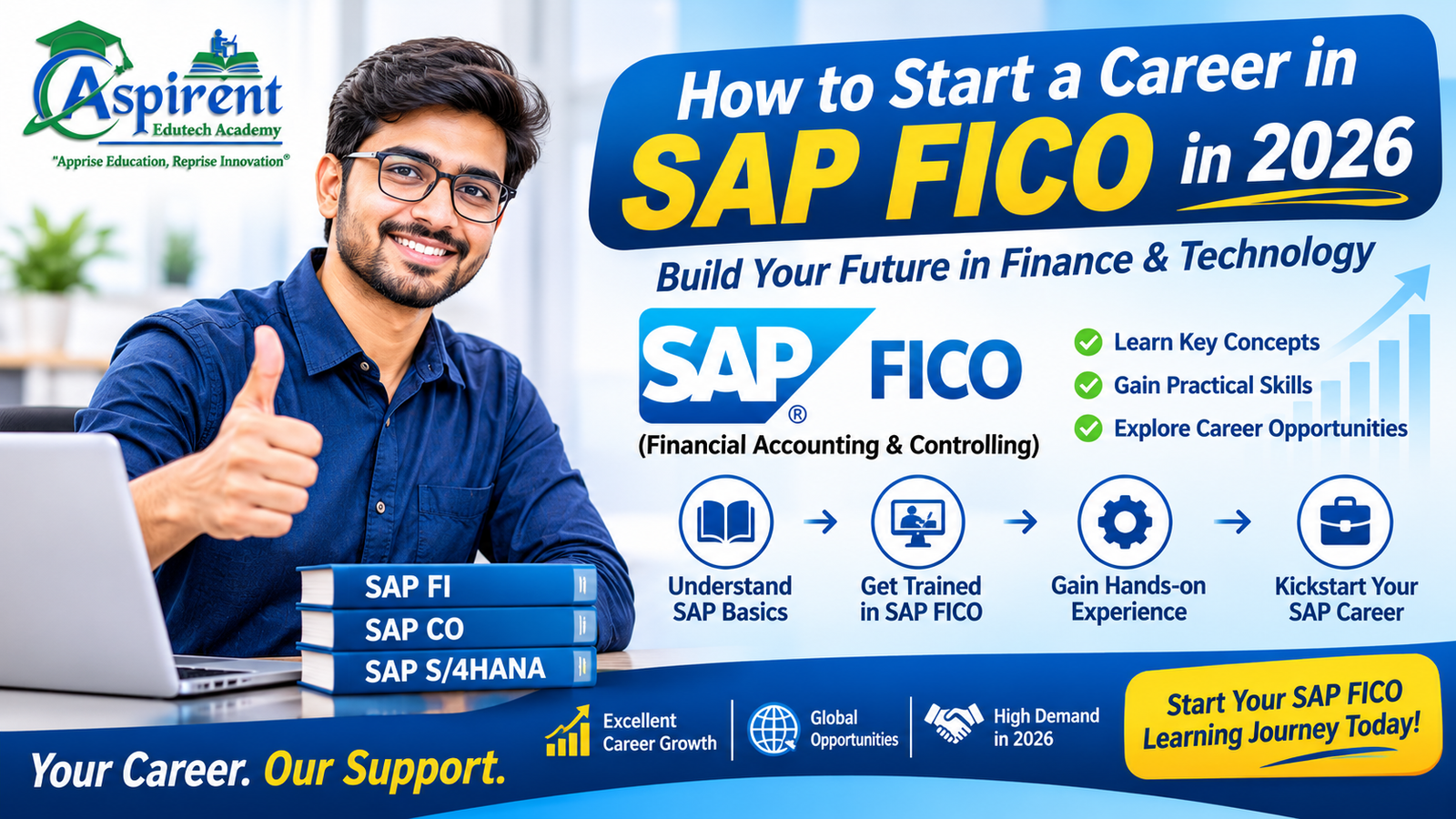
How to Start a Career in SAP FICO in 2026: A Complete Beginner's Guide
Are you looking to build a rewarding career in finance, accounting and technology? If yes, starting an SAP FICO career in 2026 could be an excellent option.
In today's competitive business environment, organisations need efficient financial management systems to manage accounting, financial reporting, budgeting and cost control. SAP is one of the widely used enterprise software solutions that helps businesses manage these important operations.
SAP FICO (Financial Accounting and Controlling) is one of the important functional areas of SAP ERP. It helps organisations manage their financial transactions, monitor expenses, analyse profitability and maintain accurate financial records.
Whether you are a B.Com graduate, M.Com student, MBA Finance professional, CA aspirant or working accountant, learning SAP FICO can help you develop specialised professional skills.
In this complete guide by Aspirent Edutech Academy, we will explain how to start a career in SAP FICO in 2026, what skills you need, which topics you should learn and how to prepare for SAP-related job opportunities.
1. What Is SAP FICO?
SAP FICO stands for Financial Accounting (FI) and Controlling (CO).
It is a functional module of SAP that helps businesses manage their financial accounting and internal cost management activities.
The two major components are:
SAP FI – Financial Accounting
SAP FI manages the financial transactions and reporting requirements of an organisation.
Important SAP FI components include:
- General Ledger Accounting (GL)
- Accounts Payable (AP)
- Accounts Receivable (AR)
- Asset Accounting (AA)
- Bank Accounting
- Financial Statements
- Tax Accounting
- Financial Closing
SAP CO – Controlling
SAP CO focuses on internal cost management, financial planning and profitability analysis.
Important SAP CO components include:
- Cost Centre Accounting
- Profit Centre Accounting
- Internal Orders
- Product Costing
- Profitability Analysis (CO-PA)
- Cost Element Accounting concepts
Together, SAP FI and CO help organisations maintain financial transparency and make better business decisions.
2. Why Choose an SAP FICO Career in 2026?
The demand for professionals with enterprise software and financial process knowledge continues to create opportunities across different industries.
Companies use SAP solutions to manage their business operations, financial transactions and reporting requirements.
Here are some reasons to consider an SAP FICO career in 2026.
1. Opportunities Across Industries
SAP Finance skills are relevant to organisations in manufacturing, banking, IT services, retail, consulting, pharmaceuticals and other industries.
2. Combination of Finance and Technology
SAP FICO combines accounting knowledge with enterprise technology. This makes it a suitable career direction for finance graduates interested in technology-driven business operations.
3. Multiple Career Paths
After gaining the necessary knowledge and experience, you can explore positions such as:
- SAP FICO Consultant
- SAP FI Functional Consultant
- SAP CO Consultant
- SAP Support Analyst
- SAP Finance Analyst
- SAP Implementation Consultant
- SAP Finance End-User
4. Opportunities for Professional Growth
With practical experience, you can progress towards senior functional consultant, solution specialist, project lead and SAP finance management roles.
5. International Career Exposure
SAP is used by organisations across the world. Professionals with relevant SAP experience may explore opportunities in different countries, depending on their qualifications and experience.
3. Who Can Start Learning SAP FICO?
One of the biggest advantages of SAP FICO is that learners from different educational and professional backgrounds can start learning it.
The following candidates may consider SAP FICO training:
| Educational Background | How SAP FICO Can Help |
| B.Com | Develop practical accounting and ERP knowledge |
| M.Com | Strengthen financial management skills |
| MBA Finance | Understand enterprise financial processes |
| CA / CMA Aspirants | Build ERP and financial reporting knowledge |
| BBA Finance | Learn business accounting processes |
| Working Accountants | Upgrade accounting and ERP skills |
| Finance Executives | Develop specialised SAP knowledge |
Do you need an IT background?
No. A programming background is generally not required to begin learning SAP FICO as a functional consultant.
However, basic accounting knowledge, logical thinking and an interest in business processes will make learning easier.
4. Important Topics to Learn in SAP FICO
If you want to establish a strong SAP FICO career, you should focus on both theoretical concepts and practical system knowledge.
Here are the major topics you should learn.
A. SAP Financial Accounting (FI)
Start with the fundamentals of financial accounting.
Important topics include:
- Enterprise Structure
- Company Code
- Chart of Accounts
- Fiscal Year Variant
- Posting Period Variant
- General Ledger Accounting
- Accounts Payable
- Accounts Receivable
- Asset Accounting
- Bank Accounting
- Tax Configuration
- Automatic Payment Program
- Financial Reporting
B. SAP Controlling (CO)
After understanding Financial Accounting, move towards Controlling.
Important topics include:
- Controlling Area
- Cost Centre Accounting
- Profit Centre Accounting
- Internal Orders
- Cost Allocation
- Product Costing
- Profitability Analysis
- Cost Assessment
- Planning and Budgeting
C. SAP S/4HANA Finance
In 2026, learners should also understand SAP S/4HANA Finance.
SAP S/4HANA is SAP's modern ERP platform, and its Finance capabilities support financial accounting, management accounting and integrated business processes.
Important areas to explore include:
- Universal Journal
- Business Partner
- SAP Fiori Applications
- Financial Reporting
- Financial Closing
- Integration with Other SAP Modules
Learning SAP S/4HANA Finance alongside traditional FI/CO concepts can help prepare you for modern SAP environments.
5. Step-by-Step Guide to Starting an SAP FICO Career in 2026
If you are a beginner, follow this structured learning approach.
Step 1: Understand Basic Accounting
Before learning SAP FICO, develop a good understanding of accounting fundamentals.
Focus on:
- Journal Entries
- Ledger Accounts
- Trial Balance
- Profit and Loss Account
- Balance Sheet
- Accounts Payable and Receivable
- Depreciation
- Bank Reconciliation
These concepts will help you understand how financial transactions are recorded in SAP.
Step 2: Learn SAP Fundamentals
Understand what SAP is, how ERP systems work and how different departments interact within an organisation.
Learn the basics of SAP navigation, organisational structure and business processes.
Step 3: Enrol in Professional SAP FICO Training
Choose a structured SAP FICO training programme that covers both Financial Accounting and Controlling.
Your training should include:
- Complete FI and CO concepts
- SAP S/4HANA Finance fundamentals
- Practical system demonstrations
- Business process understanding
- Configuration concepts
- Real-world business scenarios
- Interview preparation
Step 4: Get Practical SAP System Experience
Practical knowledge is extremely important.
Try to understand how to perform common business transactions and how different accounting processes work inside SAP.
Practise scenarios such as:
- Creating vendor and customer master data
- Posting journal entries
- Processing vendor invoices
- Recording customer payments
- Asset acquisition and depreciation
- Bank reconciliation
- Cost centre postings
- Financial reporting
Step 5: Prepare for SAP FICO Interviews
After completing your training, prepare for technical and functional interviews.
Focus on understanding business processes rather than simply memorising transaction codes.
Prepare to explain how you would handle common accounting situations using SAP.
Step 6: Build Your Resume and Apply for Jobs
Create a professional resume highlighting:
- Educational qualifications
- Accounting knowledge
- SAP FI and CO skills
- SAP S/4HANA knowledge
- Practical training
- Practice assignments and projects
Freshers can explore entry-level finance ERP roles, SAP support positions, trainee opportunities and finance operations roles.
6. What Are the Career Opportunities After SAP FICO Training?
After learning SAP FICO and developing practical knowledge, you can explore different professional roles.
Some common career options include:
| Job Role | Main Responsibilities |
| SAP FICO Consultant | Configure and support SAP finance processes |
| SAP FI Consultant | Manage financial accounting processes |
| SAP CO Consultant | Manage cost and profitability processes |
| SAP Support Analyst | Resolve SAP-related business issues |
| SAP Finance Analyst | Analyse financial information and reports |
| SAP End-User | Perform daily financial transactions in SAP |
| SAP Functional Consultant | Understand business requirements and implement SAP solutions |
Your actual eligibility for these positions will depend on your education, practical experience and employer requirements.
7. Is SAP FICO Good for Freshers?
Yes, freshers can learn SAP FICO and build a career in the SAP finance domain.
However, it is important to understand that completing a course alone does not guarantee an SAP consultant job.
Freshers should focus on building three important areas:
Accounting Knowledge: Understand fundamental financial and accounting processes.
SAP Practical Knowledge: Learn how transactions and business processes work within SAP.
Communication Skills: Develop the ability to explain financial processes, understand business requirements and communicate with teams.
Freshers should initially explore opportunities in finance operations, SAP support, ERP trainee and junior analyst positions.
With relevant experience, they can gradually move towards specialised SAP functional consulting roles.
8. How Long Does It Take to Learn SAP FICO?
The learning duration depends on your educational background, previous accounting knowledge and learning schedule.
A structured beginner learning plan could look like this:
| Learning Stage | Suggested Duration |
| Accounting Fundamentals | 2–3 Weeks |
| SAP Fundamentals | 1–2 Weeks |
| SAP FI Module | 4–6 Weeks |
| SAP CO Module | 3–4 Weeks |
| S/4HANA Finance Concepts | 2–3 Weeks |
| Practical Training and Interview Preparation | 2–4 Weeks |
These are suggested learning periods, not guaranteed completion times. Some learners may need additional time for practical exercises and revision.
9. SAP FICO Certification: Is It Important?
SAP certification can help demonstrate your knowledge of a particular SAP solution and learning path.
However, certification should be combined with practical knowledge and an understanding of business processes.
SAP provides official learning journeys for Financial Accounting and Management Accounting in SAP S/4HANA.
Before selecting a certification, check the latest examination requirements, available certification options and relevant learning materials through SAP's official website.
Official learning resources:
https://www.sap.com/certification
10. Tips to Build a Successful SAP FICO Career
Here are some practical tips to improve your career preparation.
- Strengthen your accounting fundamentals.
- Learn both SAP FI and SAP CO.
- Understand SAP S/4HANA Finance.
- Practise business transactions using an authorised SAP training system.
- Learn how finance integrates with other SAP modules.
- Improve Excel and financial reporting skills.
- Prepare for technical and functional interviews.
- Build a professional LinkedIn profile.
- Follow SAP learning resources and industry developments.
- Keep upgrading your skills as SAP technology evolves.
Remember, successful SAP professionals need a combination of functional knowledge, practical understanding and problem-solving skills.
11. Start Your SAP FICO Learning Journey with Aspirent Edutech Academy
Are you searching for the right place to start your SAP FICO learning journey?
Aspirent Edutech Academy aims to help students and working professionals develop industry-relevant skills through career-oriented training.
If you want to build a career in finance, accounting and enterprise resource planning, learning SAP FICO can be an important step towards your professional development.
Our SAP FICO training enquiry programme is designed to help aspiring learners understand the SAP Finance domain and prepare for relevant career opportunities.
By choosing the right learning path, developing practical knowledge and preparing consistently, you can work towards your goal of becoming an SAP FICO professional.
Take the first step towards your SAP FICO career in 2026!
Visit: https://www.aspirent.in/
Contact Aspirent Edutech Academy to enquire about SAP FICO training, course details and available learning options.
12. Frequently Asked Questions (FAQs) About SAP FICO Career
Q1. What is SAP FICO, and why should I learn it in 2026?
SAP FICO is the Financial Accounting and Controlling area of SAP. It helps organisations manage financial transactions, accounting records, cost management and financial reporting. Learning SAP FICO can help you develop specialised skills for finance and ERP-related career opportunities.
Q2. Can a B.Com student learn SAP FICO?
Yes. B.Com graduates can learn SAP FICO. Their accounting background can help them understand Financial Accounting, General Ledger, Accounts Payable and Accounts Receivable.
Q3. Is SAP FICO difficult for beginners?
SAP FICO is manageable for beginners who have basic accounting knowledge and follow a structured learning programme. Regular practice and understanding business processes are important.
Q4. Is coding required for an SAP FICO career?
No. Coding is generally not required for functional SAP FICO roles. Functional consultants mainly work with business processes, configuration and system functionality.
Q5. What is the difference between SAP FI and SAP CO?
SAP FI focuses on external financial accounting and reporting, whereas SAP CO focuses on internal cost management, controlling and profitability analysis.
Q6. Can freshers get jobs after SAP FICO training?
Yes, freshers can explore entry-level opportunities in finance operations, ERP support, SAP trainee and junior analyst roles. However, employment depends on practical knowledge, communication skills, qualifications and employer requirements.
Q7. Should I learn SAP FICO or SAP S/4HANA Finance?
For learners starting in 2026, it is useful to understand traditional SAP FI/CO fundamentals alongside SAP S/4HANA Finance. This combination provides a broader understanding of SAP's finance environment.
Q8. Is SAP FICO certification compulsory?
Certification is not compulsory for every SAP finance-related job. However, an appropriate SAP certification may help demonstrate your knowledge and professional learning.
Q9. What should I learn before joining SAP FICO training?
You should understand basic accounting concepts such as journal entries, ledger accounts, trial balance, balance sheets, profit and loss statements and bank reconciliation.
Q10. Where can I learn SAP FICO in 2026?
You can explore structured SAP FICO training programmes through professional training institutes such as Aspirent Edutech Academy. Before enrolling, check the syllabus, practical system access, trainer experience and course support.
Conclusion
Building an SAP FICO career in 2026 can be a promising career direction for graduates, finance professionals and individuals interested in enterprise technology.
Start by strengthening your accounting knowledge, learn SAP FI and CO, understand SAP S/4HANA Finance and gain practical experience.
Most importantly, remember that professional growth comes from continuous learning and practical skill development.
If you are ready to take the next step towards a career in SAP Finance, connect with Aspirent Edutech Academy and explore your SAP FICO learning opportunities.
Your career journey starts with the right skills. Start learning today!


Comments (0)
No comments yet. Be the first to share your thoughts!